myfy
Opinionated Python framework with modularity, ergonomics, and power
Why Another Framework?
You've built enough Python apps to know: FastAPI is brilliant for APIs but barebones for real apps. Django's too heavy and too coupled. Flask feels like duct tape.
What if you could have:
- FastAPI's ergonomics (decorators, type hints, async-first)
- Enterprise-grade architecture (DI container, module system, lifecycle)
- Sensible defaults (no config files until you need them)
myfy is that framework. Opinionated where it matters, flexible everywhere else.
60-Second Example
Full-Stack App with Frontend
Build a complete web app with DaisyUI components:
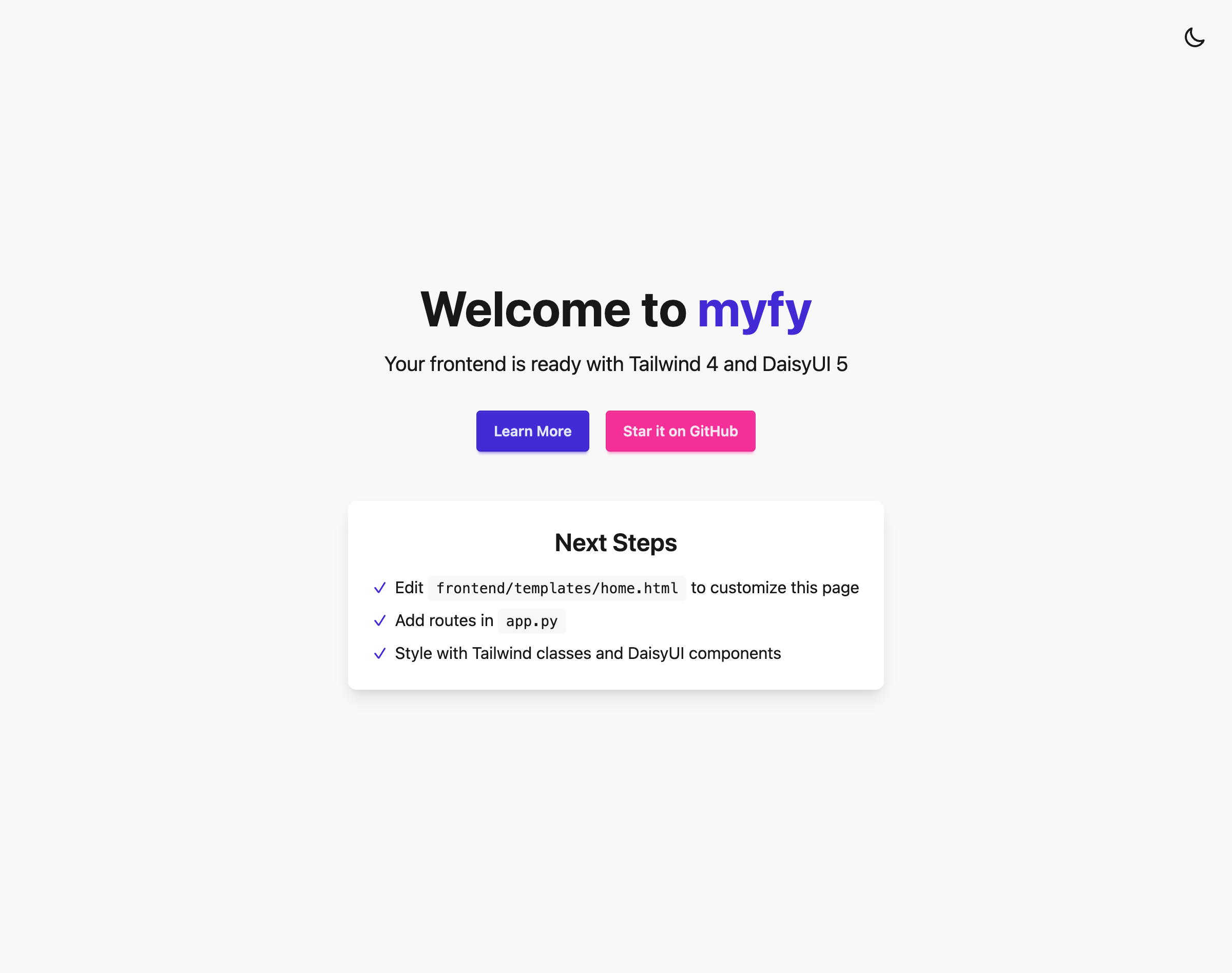
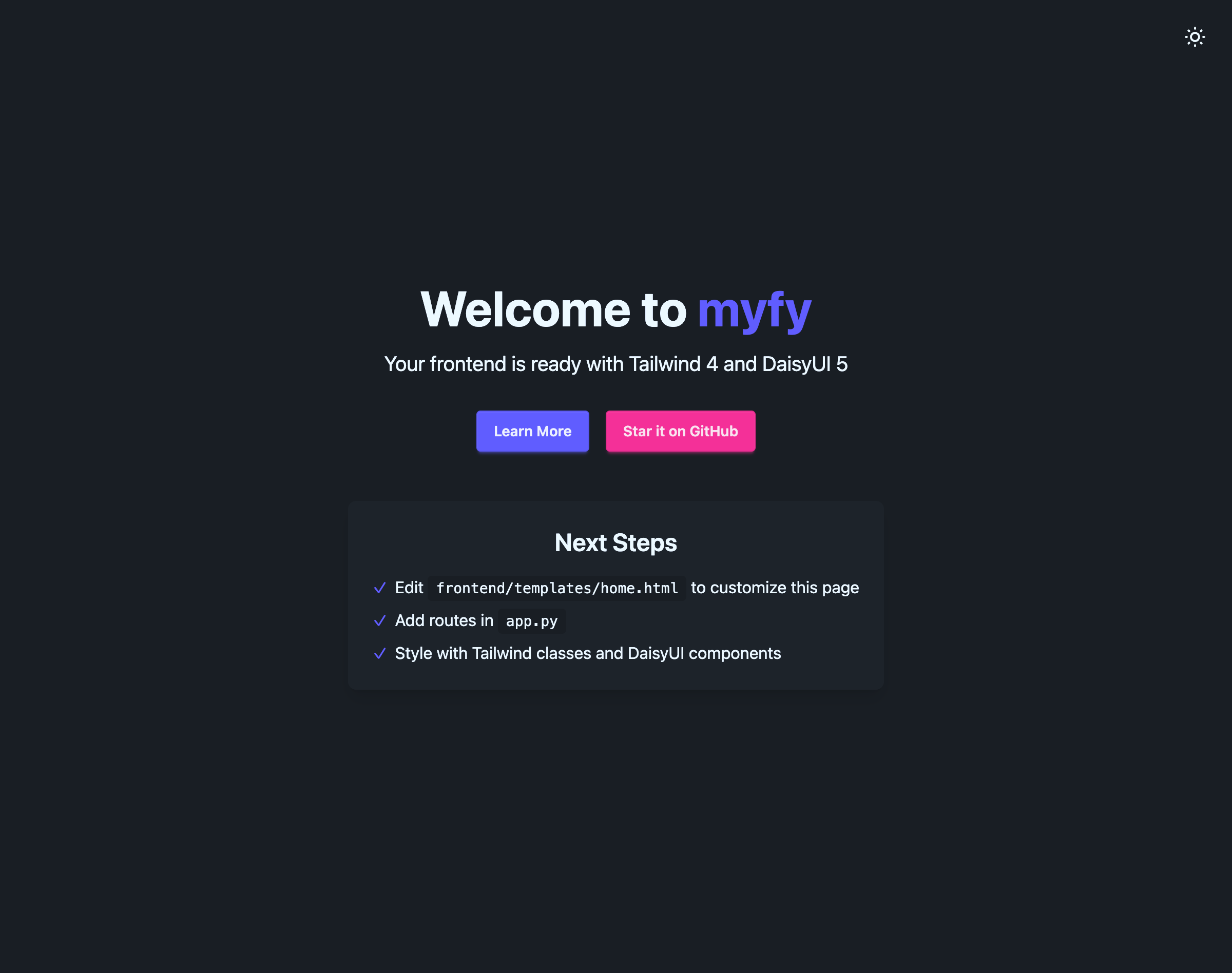
This creates app.py and frontend/ with Tailwind 4 + DaisyUI 5:
from myfy.core import Application
from myfy.web import WebModule, route
from myfy.frontend import FrontendModule, render_template
from starlette.requests import Request
from starlette.templating import Jinja2Templates

@route.get("/")
async def home(request: Request, templates: Jinja2Templates):
    return render_template(
        "home.html",
        request=request,
        templates=templates,
        title="Welcome to myfy"
    )

app = Application(auto_discover=False)
app.add_module(WebModule())
app.add_module(FrontendModule())
Run it:
Visit http://127.0.0.1:8000 - styled UI with DaisyUI, instant HMR, ready to ship.
API-Only Example
Build a REST API with DI and validation:
from myfy.core import Application, provider, SINGLETON, BaseSettings
from myfy.web import route, WebModule
from pydantic import Field

# 1. Settings (auto-loads from .env)
class Settings(BaseSettings):
    app_name: str = Field(default="My App")
    api_key: str

# 2. Services (constructor-injected)
class UserService:
    def __init__(self, settings: Settings):
        self.settings = settings

    def greet(self, name: str) -> str:
        return f"Hello {name} from {self.settings.app_name}!"

@provider(scope=SINGLETON)
def user_service(settings: Settings) -> UserService:
    return UserService(settings)

# 3. Routes (DI + path params + type conversion)
@route.get("/greet/{name}")
async def greet_user(name: str, service: UserService) -> dict:
    return {"message": service.greet(name)}

# 4. Run
app = Application(settings_class=Settings, auto_discover=False)
app.add_module(WebModule())
Run it:
Visit http://127.0.0.1:8000/greet/World
What Makes myfy Different
Modules That Actually Work
Real, composable modules with their own lifecycle - not "blueprints":
class DataModule(BaseModule):
    async def start(self):
        await self.db.connect()

    async def stop(self):
        await self.db.disconnect()

app.add_module(DataModule())
app.add_module(WebModule())
Dependency Injection Without Magic
Type-based DI that's fast (zero reflection on hot path) and safe (compile-time validation):
@provider(scope=SINGLETON)
def database(settings: Settings) -> Database:
    return Database(settings.db_url)

@route.post("/users")
async def create_user(body: CreateUserDTO, db: Database):
    return await db.create_user(body)
Defaults That Make Sense
One file. No config. Just run.
Getting Started
-
Installation
Install myfy and create your first app in 5 minutes
-
Tutorial
Build a complete application step-by-step
-
Reference
Single-page reference for all myfy features
-
Core Concepts
Deep dive into DI, modules, configuration, and lifecycle
Key Features
| Feature | Description |
|---|---|
| Type-Safe DI | Constructor injection with SINGLETON, REQUEST, and TASK scopes |
| Module System | First-class modules with lifecycle hooks (start/stop) |
| FastAPI-Style Routes | Decorators, path params, automatic body parsing |
| Query Validation | Built-in query parameter parsing with constraints (ge, le, min_length, pattern) |
| WebError Hierarchy | RFC 7807 Problem Details errors (NotFound, BadRequest, Conflict, etc.) |
| Configuration Profiles | Environment-based config (dev/test/prod) with Pydantic validation |
| Data Module | Async SQLAlchemy 2.0+ with REQUEST-scoped sessions |
| CLI Tools | Built-in commands: run, routes, modules, doctor |
| Zero Reflection | All DI resolution at compile-time, not request-time |
| Async-Native | ASGI + AnyIO throughout |
Next Steps
New to myfy? Start with the Installation Guide and Tutorial
Want to understand the architecture? Read about Dependency Injection, Modules, and Configuration
Want to contribute? See our Contributing Guide
Philosophy
Built on core principles: - Opinionated, not rigid - Strong defaults but fully customizable - Defaults by default - Zero config to start, infinite config to scale - Pythonic over ceremonial - Type hints, decorators, async/await - Modular by design - Tiny kernel, add what you need - Zero reflection on hot path - All analysis at startup
Read the full philosophy: PRINCIPLES.md
Community & Support
- GitHub: Issues & Discussions
- Examples: examples/
License
MIT